Reviewed · LALIBELA
5 DAYS Lalibela, Axum, Tigray churches and Danakil
The big idea here is hard to beat: in just five days, you move from Lalibela’s hand-carved churches and Axum’s ancient ruins to the sulfur colors of Dallol and the heat of Erta Ale. Few Ethiopian trips pack such a sharp contrast of sacred stonework, old kingdoms, active volcanoes, salt mines, and Afar culture into one route.
I like two things especially. First, the three domestic Ethiopian Airlines flights turn a huge country into a manageable trip. Second, the private format lets the operator adjust plans when conditions change. The tradeoff is serious: the Danakil section is physically tough, with rough roads, basic camp conditions, heat, walking, and very early starts. This is not a gentle sightseeing holiday.
Key points at a glance
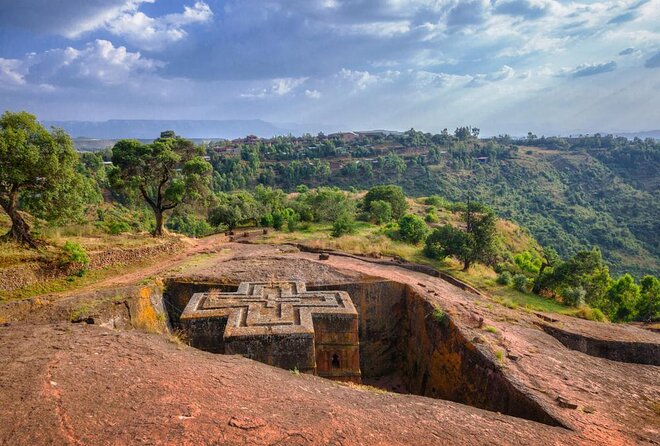
- Lalibela in one afternoon: Visit the northern group of UNESCO-listed rock-hewn churches after flying in from Addis Ababa.
- Axum and Gheralta in one day: See Axum’s ancient remains, then drive through Adwa and the Gheralta plains toward Hawzien.
- Erta Ale requires stamina: Reach the volcano by a rough 80-kilometer road, then walk uphill to the crater area.
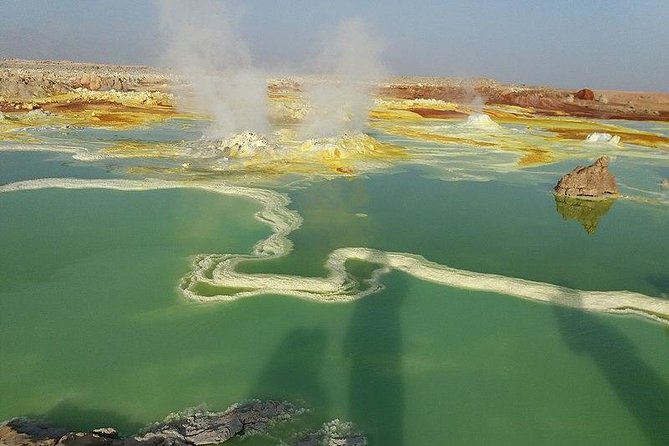
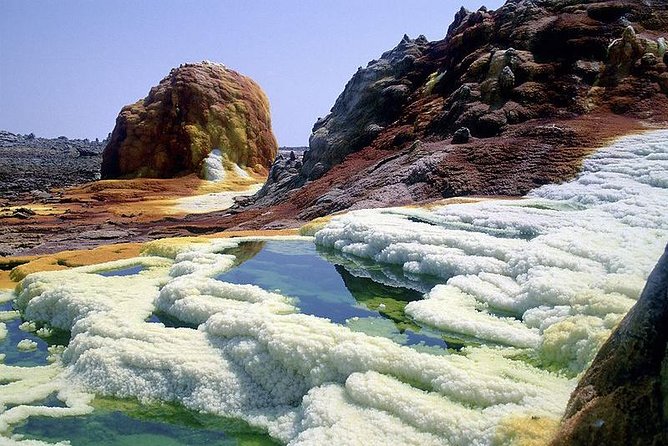
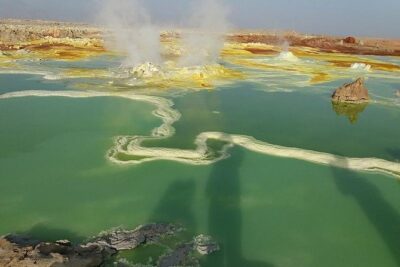
- Dallol is the visual high point: Colorful mineral deposits, salt mining, Lake Assal, and camel caravans form the final Danakil outing.
- Private travel adds flexibility: Only your group takes part, which matters when weather, road conditions, or regional tensions affect plans.
- The price covers key transport and meals: At $1,025.65 per person, the value rests largely on the flights, private logistics, and difficult-to-arrange Danakil access.
Why this five-day route is so unusual
Most short trips to northern Ethiopia focus on one region. This one tries to connect three very different worlds.
You begin with Lalibela, where churches were cut downward into volcanic rock during the reign of King Lalibela, from 1181 to 1221. You then reach Axum, a former center of power, before driving into Tigray’s dry highlands and Gheralta country. The final three days shift from archaeology and worship to volcanoes, salt, heat, and Afar communities.
That variety is the main reason to consider the trip. You are not spending five days looking at similar monuments. Each day changes the feel of the journey.
The schedule also makes clear why the operator uses flights. Driving from Addis Ababa to all these places would consume far more time. The flights to Lalibela and Axum, followed by the flight back from Mekele, give you access to remote areas without losing several days on the road.
Still, five days is tight. Lalibela gets only an afternoon in the stated plan. Axum gets a few hours before the long road journey to Hawzien. The route favors range over a slow, detailed look at each place.
More Danakil Expeditions in Addis Ababa
- 12 Days SIMIEN MOUNTAIN-LALIBELA-DANAKIL-TIGRAY CHURCHES
★ 5.0 · 45 reviews - 3 Day Danakil Depression Ertale and Dallol Tours
★ 5.0 · 44 reviews - 2-Night 3-Day Danakil Depression Tour without Flights
★ 4.8 · 31 reviews
Lalibela’s churches: a powerful first afternoon
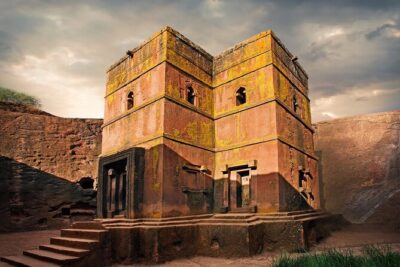
After a morning flight north, you are transferred to your hotel and have lunch before visiting the first group of churches. These buildings sit north of a small stream known as the Jordan River.
The churches were carved directly from the rock, not assembled from blocks. That simple fact changes how you see them. Instead of entering a building that was placed on the ground, you look down into courtyards and cuts in the stone, then move through a sacred complex shaped from the earth itself.
Lalibela has about eleven rock-hewn churches arranged in groups. The first afternoon concentrates on the northern group, so you should not expect a leisurely survey of every church. The admission ticket is included, and the overnight stay is listed at Lalibela Lodge.
I would treat this as an introduction rather than a full Lalibela visit. The timing is useful if you want to connect the town with Axum and Danakil, but it leaves little room for a slow morning, extra church visits, or a second look at details you missed.
The benefit is momentum. You get one of Ethiopia’s most important historic sites immediately, then continue north the next morning. If Lalibela is your main reason for coming to Ethiopia, a longer standalone stay would make more sense. If you want a broad northern route, this short visit gives you a meaningful sample.
Axum to Hawzien: ancient ruins and a long road
Day two begins with a flight from Lalibela to Axum. The visit to Axum lasts several hours before the road journey begins.
The ruins of Axum provide a change in scale from Lalibela. Here, the focus is not on churches carved into rock but on the remains of an old city and kingdom. The stop is followed by a 190-kilometer drive to Hawzien, described as taking about two hours, via Adwa and the Gheralta plains.
That timing may be optimistic in real road conditions, so keep your schedule flexible. The point of this day is not only Axum itself. Hawzien places you near the rock-hewn churches of Gheralta, which are the reason to use the town as a base.
The overnight accommodation is listed as Gerealta Lodge or Wukro Lodge. Since the supplied inclusions list meals and flights but does not spell out every lodging detail, confirm the exact hotel arrangements before booking.
This is a demanding transition day. You fly in the morning, spend hours at an important archaeological site, then drive across Tigray. You also move from a town visit into a more remote setting. That change prepares you for the Danakil portion, but it leaves little spare time.
Erta Ale: the hardest day comes first
The Danakil section starts with a drive toward Erta Ale through Mekele. In the Afar language, Mekele means smoky mountain. Erta Ale is a shield volcano with a base diameter of about 30 kilometers and a summit caldera roughly one kilometer square.
Its main attraction is the lava lake. The volcano is about 613 meters high, and the lake is described as one of only five permanent lava lakes in the world. It has reportedly existed since the early years of the twentieth century.
The numbers help explain the appeal, but they also explain the effort. You begin around 9:00 in the morning and drive to Dodom, at the volcano’s base. The route covers about 80 kilometers on what is described as one of the roughest roads in the world.
That road is not a minor inconvenience. It affects comfort, speed, and energy. A rough ride followed by walking to the crater can make this the most tiring part of the entire trip. The tour requires a moderate level of physical fitness, and that wording should be taken seriously.
At Erta Ale, you camp overnight. The supplied plan does not provide detailed information about tents, bedding, washing facilities, or meals at camp, so ask for current conditions before you commit. You should also expect conditions to be basic compared with a hotel in Lalibela or Hawzien.
The reward is a rare natural setting. You are not simply stopping at a viewpoint beside a road. You are reaching a remote volcanic site and spending the night near it. That sense of distance is central to the experience, but so are heat, dust, rough transport, and limited comfort.
More Historic North Tours in Addis Ababa
- Addis Ababa: Debre Libanos, Blue Nile Gorge, and Cave Tour
★ 4.5 · 256 reviews - 5 DAYS Axum, Lalibela, Tigray churches and Danakil
★ 4.5 · 22 reviews - Historical tours – in five days, Addis Ababa, Axum, Laliebla and Gonder
★ 5.0 · 9 reviews - Day Trip From Addis Ababa To Debre Libanos & Blue Nile Gorge
★ 4.0 · 8 reviews
Sunrise at the crater and the road to Afrera
The fourth day begins early with sunrise near Erta Ale’s northern crater. The main pit crater is described as about 200 meters deep and 350 meters across, with three levels. The smaller southern pit is about 65 meters wide and 100 meters deep, and a central pit may be an older crater or a collapse feature.
After breakfast, the plan is to descend around 9:00 in the morning and return to Dodom, ideally by 7:00. The wording suggests that conditions can affect the exact timing, so do not treat every hour as fixed.
You should reach camp by about 10:30, rest briefly, then continue toward Lake Giulietti, also called Lake Afrera. This stop is optional and may not be available during certain conditions or seasons. That uncertainty is worth noting before you build your expectations around it.
The day combines a sunrise walk, a descent, a long vehicle journey, and a possible lake visit. It is less about checking off many formal attractions and more about seeing how quickly the volcanic terrain changes as you move through the Danakil region.
The optional nature of Lake Afrera is a good example of why a private trip helps. A private schedule can respond more easily to road conditions and local decisions than a large fixed group. It does not remove the difficulties, but it may make the operation more adaptable.
Dallol, Lake Assal, and the Afar salt route
The final Danakil morning takes you to Ragad, also called Asebo, where salt workers break salt from the ground, cut it into rectangular pieces, and load it onto camels.
This is one of the most human parts of the route. The salt is not just a strange natural feature. You see the labor and transport system connected with it, then continue to Dallol and Lake Assal.
Dallol lies about 116 meters below sea level and is known for mineral colors created by volcanic activity. The setting can look almost unreal, with salts and hot geological processes producing strong contrasts. This is a place where you should follow the guide closely and respect all safety instructions.
The plan also includes following camel caravans and walking with Afar people. Camel caravans are not available in July, August, and early September, so the season affects what you see. If this part matters to you, confirm the dates before paying.
After Dallol and Lake Assal, you return to Hamedela and continue to Mekele. The final flight leaves at 7:50 in the evening and reaches Addis Ababa at 9:10.
That last day is extremely long, listed at 16 hours. You will need patience. The attraction is the sheer range of sights, but fatigue is part of the deal. The late flight also means the tour ends with a full day in the field, not a relaxed transfer to the airport.
What the $1,025.65 price really buys
The price is $1,025.65 per person. That is a fair figure if the three domestic flights, private vehicles, guides, permits, meals, and remote-area arrangements are all handled as expected.
Three Ethiopian Airlines flights are included. That matters because domestic air travel saves a great deal of time on a five-day route. Breakfast is included for five days, along with three lunches and three dinners. Admission tickets are also included for the listed attractions.
Tips and laundry are not included. You should also confirm the exact lodging, camping setup, bottled water arrangements, and any local fees, since those details are not fully itemized in the supplied information.
The tour has a 97 percent recommendation rate and a 4.9 rating from 34 ratings. More useful than the numbers is what the experience demands from the operator. The route involves several flights, rough roads, remote camps, changing regional conditions, and tight connections. Good organization has real value here.
A past change also shows why flexibility matters. When tensions in the country affected access, one booking was reshaped into two days in Lalibela and four days in Danakil, with Axum and Tigray removed. The operator asked what the customer preferred and arranged an alternative plan. That does not guarantee the same result for every departure, but it shows that the exact route can be affected by conditions beyond anyone’s control.
Timing, comfort, and physical effort
You need a moderate fitness level for this trip. The main challenges are not technical climbing or long-distance trekking. They are rough vehicle travel, walking near Erta Ale, heat, early starts, basic camping, and the cumulative strain of several packed days.
The Danakil region is one of the hottest and most demanding parts of Ethiopia. The supplied plan describes difficult roads and a long final day, so bring practical clothing and be ready for dust and strong sun. Because no detailed packing list is provided, ask the operator what they supply for camping and what you must bring yourself.
The private format is a clear advantage for comfort and decision-making. Only your group takes part, so you are not sharing the schedule with a large public group. That can make airport transfers and changes easier, though it cannot make an 80-kilometer rough road smooth.
The experience offers pickup, and confirmation is received at booking. Service animals are allowed, and the route is near public transportation in some areas. Those facts are useful, but they do not change the remote nature of the Danakil section.
Who should book this Ethiopian route?
I would choose this trip if you want a concentrated northern Ethiopia journey and care more about variety than a slow pace.
It suits you if:
- You want Lalibela, Axum, Tigray, and Danakil in one trip.
- You are comfortable with early starts and long transfer days.
- You can handle rough roads and simple camping.
- You value private travel and schedule flexibility.
- You accept that weather, regional tensions, and road conditions can alter the plan.
I would hesitate if Lalibela deserves several unhurried days, if you dislike heat and basic facilities, or if you need a relaxed travel rhythm. The tour covers a great deal, but it does so by keeping the days full.
Free cancellation is available up to 24 hours before the local start time. Within 24 hours, the payment is not refunded, and changes are not accepted. If poor weather cancels the experience, you are offered another date or a full refund.
My call: book it for range, not ease
This is a bold route with a sensible strength: it links Ethiopia’s most famous northern sights without wasting days on long overland travel from Addis Ababa.
I like the combination of Lalibela’s carved churches, Axum’s ruins, Gheralta access, Erta Ale, Dallol, and the salt route. I also value the private arrangement and the operator’s apparent willingness to adjust plans when conditions change.
But you should book with clear expectations. You may spend only a short time at major historic sites, and the Danakil portion is hot, rough, remote, and tiring. If that sounds like the price of seeing places few short tours can connect, the $1,025.65 cost offers strong value. If you want comfort or depth at each stop, choose a slower trip.
FAQ
How long is the experience?
The experience lasts approximately five days.
Where does the tour begin?
The tour is based in Addis Ababa, Ethiopia, and pickup is offered.
Are domestic flights included?
Yes. Three domestic Ethiopian Airlines flights are included.
Which destinations are visited?
The planned route includes Lalibela, Axum, Hawzien and the Gheralta area, Erta Ale, Lake Afrera if available, Dallol, Lake Assal, Hamedela, and Mekele.
How many rock-hewn churches can I see in Lalibela?
Lalibela has about eleven rock-hewn churches arranged in groups. The first afternoon visits the first group, located north of the Jordan River.
What is included in the meals?
Breakfast is included for five days. Three lunches and three dinners are also included.
Is the Danakil section physically difficult?
Yes. The tour requires a moderate level of physical fitness and includes rough roads, walking near Erta Ale, early starts, and basic overnight conditions.
Is Lake Afrera guaranteed?
No. The visit to Lake Afrera is optional and may not be available during some conditions or seasons.
Are camel caravans available all year?
No. Camel caravans are not available in July, August, and early September.
Is this a private tour?
Yes. Only your group participates in the private activity.
What is not included?
Tips and laundry are not included. The available details also advise confirming exact lodging and camping arrangements before booking.
Can I cancel for a full refund?
You can cancel for a full refund at least 24 hours before the experience begins. Cancellations within 24 hours are not refunded. Poor-weather cancellations offer a different date or a full refund.
More Danakil Depression Expeditions
- 9 Days Tours To Danakil Depression, Simen MNP, Lalibela With Omo Valley Tribes
★ 5.0 · 11 reviews - 5 Days Lalibela-Danakil Tour
★ 4.5 · 11 reviews - 8 Days Lalibela,Danakil Depression and Omo Vally Tours
★ 5.0 · 10 reviews - 3 Day Danakil Depression Dallol & Ertale Tours
★ 5.0 · 9 reviews
More Rock-Hewn Church Tours in Addis Ababa
- Danakil Depression and Lalibela 5 Days Tours
★ 5.0 · 28 reviews - Danakil Depression, Lalibela, Omo Valley and Simien Mountains
★ 5.0 · 23 reviews - 6 Days Lalibela, Omo Valley and Harar
★ 5.0 · 15 reviews - Lalibela 3 Days/ 2 Nights Tour package
★ 5.0 · 13 reviews
Just added around Addis Ababa
- 6 days 5 nights Addis Abeba sightseeing & Lalibela Rock-Hewn Churches★ 5.0 · 3 reviews
- 4 Hours Addis Ababa Cultural Discovery Tour★ 5.0 · 3 reviews
- Addis Ababa Essentials: Flexible Full-Day City Sightseeing★ 5.0 · 3 reviews
- Day Trip Around Addis Ababa★ 5.0 · 3 reviews
- Northern Ethiopia (Historic route)★ 5.0 · 3 reviews
- Monastic Marvels Exploring the beauty of Debre Libanos Monastery★ 5.0 · 3 reviews
- Addis Ababa Half Day Shopping Tour★ 5.0 · 3 reviews
- 6 days Omo valley cultural Tour★ 5.0 · 3 reviews
Lalibela Rock-Hewn Churches, compared.
12 Days SIMIEN MOUNTAIN-LALIBELA-DANAKIL-TIGRAY CHURCHES
Read our review →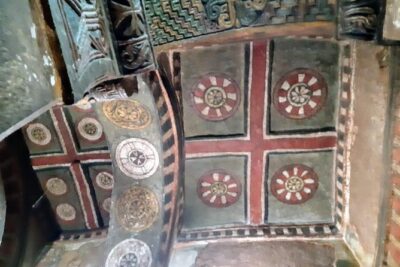
Tour 11 monolithic rock churches & museum in Lalibela & cave church with mummies
Read our review →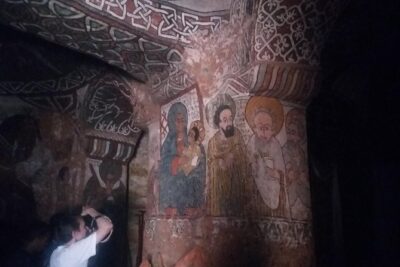
Ethiopia Tigray Tours: Guided tour of Tigray rock hewn churches
Read our review →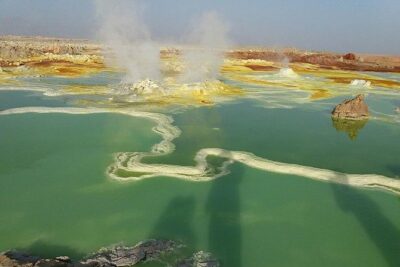
6 Days tour Package (Simien Mountains, Lalibela, and Danakil Depression)
Read our review →
Lalibela, Axum, Danakil and Omo Valley 8 DAYS
Read our review →